
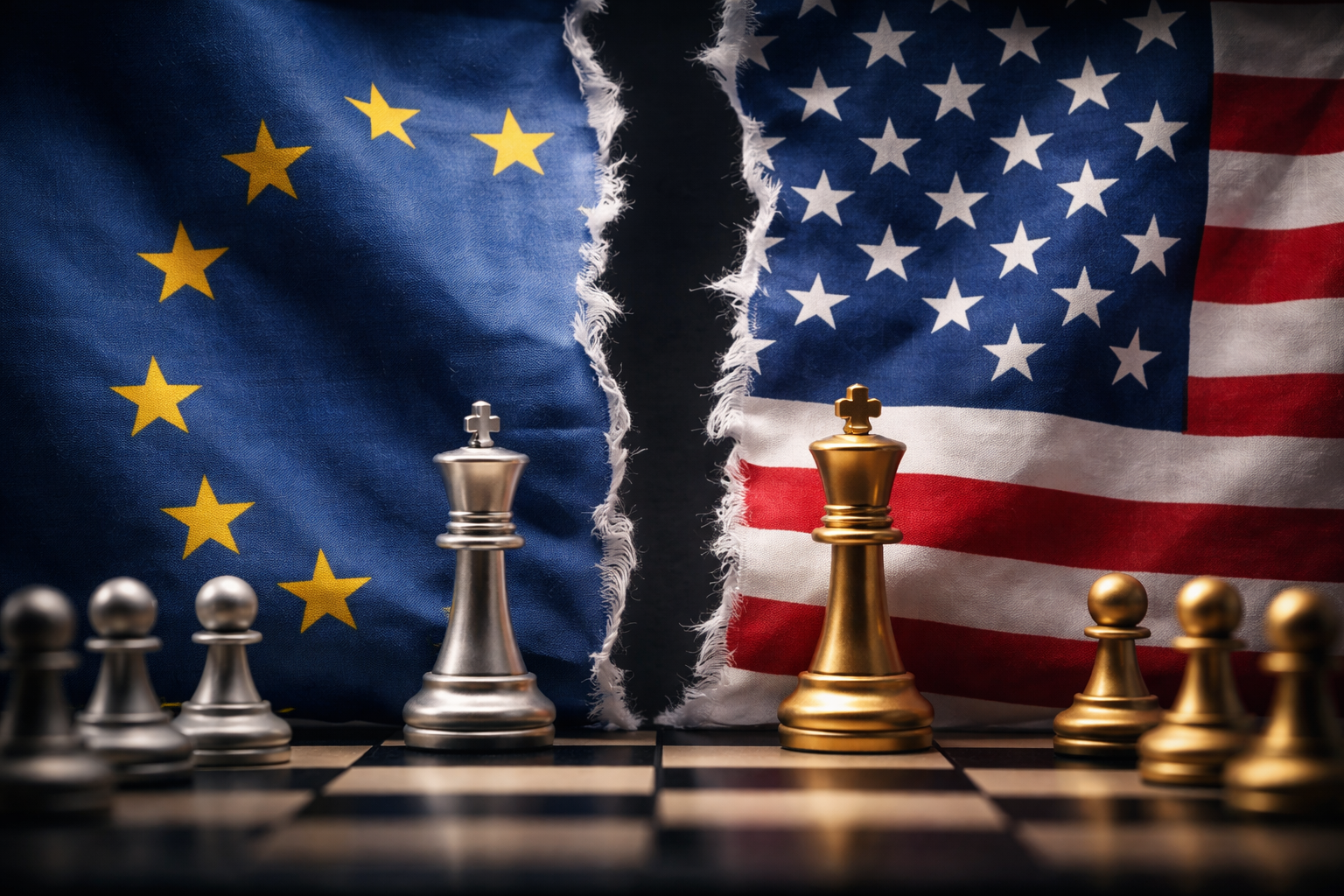
The hard truth that Europe is slowly realizing is that the United States is not a predictable, rules-anchored guarantor of its security anymore.
Perhaps it’s not even a stable trading partner.
The old “Atlantic bond” now feels like a subscription service for Europe, and maybe this is the best time to cancel.
In recent weeks, European finance ministries, defense planners, and central bankers have all been forced to revisit decisions they thought were settled years ago.
The end of assumed protection
The Greenland episode was never really about Greenland. It was about discovering that old guarantees no longer behave like guarantees.
It taught everyone that trade agreements can be reopened without warning, security commitments can be tested publicly, and that markets react faster than diplomats.
Since 1945, Europe treated these risks as theoretical, but now they have been priced in.
The US administration’s readiness to link tariffs, security, and territorial demands in a single negotiation broke a psychological barrier.
Even when those threats were later withdrawn, the damage was done. European policymakers understood that predictability itself had become scarce.
What makes this moment different from previous transatlantic disputes is the absence of a stable reference point.
In the past, Europe could wait out American cycles, confident that institutions would reassert themselves. Today, central banks worry openly about political interference.
Trade officials assume deals can be reopened. Defense planners treat US backing as conditional rather than automatic.
That forces a reordering of priorities. Not dramatic statements, but changes in budgeting, procurement, and capital allocation. These moves are already underway.
Europe’s hidden leverage and its limits
One of the least discussed facts in this debate is that Europe remains a financial heavyweight.
The bloc exports roughly €300 billion in net savings each year, according to ECB data. A large share ends up in US assets. That capital helps finance US deficits, supports equity valuations, and keeps borrowing costs lower than they would otherwise be.
Although this is real leverage, it is also unusable in the short term.
European pension funds cannot rotate out of US markets overnight without harming their own returns. Banks rely on US Treasuries as collateral.
The euro area still lacks a single safe asset with the depth and liquidity of the Treasury market. Even when some asset managers talk about reducing dollar exposure, the process takes years.
That is why the idea of a sudden “Sell America” moment misunderstands the problem.
Europe’s influence comes from how its capital is allocated over time, not from headline threats.
The real question is whether more of Europe’s savings can be absorbed at home without lowering returns.
That depends on fixing problems that have lingered for years.
Fragmented capital markets, slow project approval, regulatory uncertainty, and high energy costs.
These are not geopolitical issues on paper, but they determine whether Europe can keep its money working inside its own economy.
Until those constraints ease, Europe remains financially powerful but strategically constrained.
Why resistance worked this time
There is a temptation to read the recent US retreat on Greenland as proof that Europe has cracked the code, but that’s not the truth.
What changed was not Europe’s strength, but Europe’s response.
Instead of rushing to appease or escalating loudly, European governments prepared credible countermeasures while keeping diplomatic channels open.
Markets did part of the work. So did quiet coordination within NATO. When an off-ramp appeared, it was taken.
This tactic showed that Europe can impose costs without trying to dominate the outcome. It also showed that escalation is not the only way to demonstrate resolve.
That approach has limits. The US still has a greater tolerance for short-term disruption.
Europe still has more to lose from a prolonged trade or security breakdown. But the episode recalibrated expectations on both sides.
It also corrected a European habit. For too long, unity was treated as an end in itself.
Here, it became a means. Temporary alignment around specific actions proved more effective than endless debates about grand strategy.
The harder reset happening inside Europe
The most difficult part of Europe’s reset has little to do with the US or Donald Trump. It is internal.
Defense spending is rising across the continent, but money alone will not fix fragmentation. Procurement remains national. Production is slow. Stockpiles are thin. True capacity requires coordination that goes well beyond headline budgets.
The same applies to the economy.
Europe overregulates innovation, underinvests in scale, and struggles to turn savings into productive investment. Energy prices remain 2-4 times higher than in the US.
That weakens the industry regardless of trade policy.
Central banks are now pulled into this debate, with the European Central Bank facing pressure from all sides.
A stronger euro hurts exporters. Higher rates weigh on already weak growth. Large defense and infrastructure plans require financing on a scale not seen in decades. Strict inflation targeting looks less suited to a world of fiscal expansion and geopolitical risk.
That does not mean abandoning independence. It means redefining how policy choices are explained and coordinated.
The ECB is already edging in that direction through more explicit communication with governments. Expect that trend to deepen.
Where Europe actually goes from here
Europe is not about to become a military superpower or a closed economic bloc. It does not need to. Its path is narrower and more technical.
First, security will drive integration where ideology failed. Joint procurement, shared logistics, and coordinated planning will advance because the alternative is unaffordable.
Second, capital will slowly be redirected inward. Not through political pressure, but through necessity.
More joint debt issuance, deeper capital markets, and larger investment vehicles are already being discussed.
They will move forward because Europe cannot fund rearmament and industrial renewal any other way.
Third, trade diversification will continue without drama. Deals with India and Latin America will not replace the US or China. They will reduce single point risk. That alone changes bargaining power over time.
Finally, relations with the US will remain tense but functional. Europe will cooperate where interests align and resist when lines are crossed.
No illusions. No grand rupture.
The reset is already happening in spreadsheets, procurement contracts, and portfolio allocations. Yes, it lacks a slogan, but that may be its strength.
The post Europe’s great reset has already started. Most people just haven’t noticed yet appeared first on Invezz