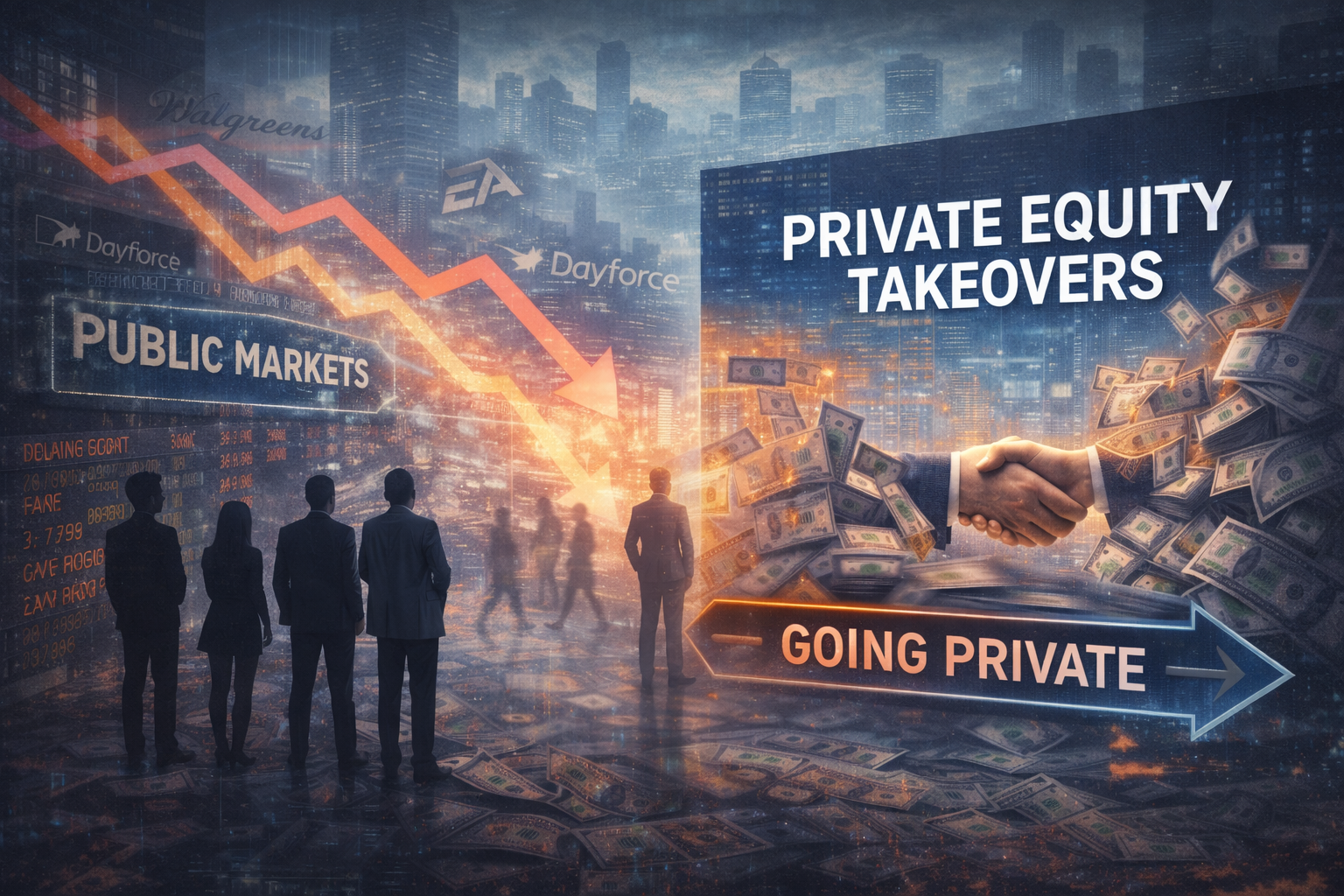
Global public markets lost a significant number of companies to private equity in 2025, as boards and investors reassessed the costs and constraints of remaining listed amid volatile markets and rising regulatory burdens.
From retail and software to gaming and human capital management, a growing number of companies opted to go private, encouraged by abundant private equity capital and valuations that sponsors view as attractive entry points.
Global take-private deal volume rose from a median of about $64 billion per quarter in 2023 to nearly $100 billion as of October 1, 2025, according to FactSet, an increase of more than 50%.
Over the past three years, 233 companies that had gone public within the previous five years were taken private, up 58% from a decade earlier.
Notably, 44 of those firms were valued at more than $1 billion, compared with just eight during the same period ten years ago.
Rising market volatility, mounting compliance costs and record levels of private equity dry powder have all contributed to the shift.
A century-long chapter closed at Walgreens
In March, Walgreens Boots Alliance agreed to be taken private by Sycamore Partners in a deal valued at up to $23.7 billion, bringing to an end nearly 100 years as a publicly traded company, with Sycamore agreeing to pay $11.45 per share in cash.
Walgreens went public in 1927, a year after opening its 100th store in Chicago, but its long tenure on public markets ended after years of declining performance.
The company’s market capitalisation lost billions of dollars over the past decade, while more than 10% of its store locations had closed.
Intense competition, pressure on pharmacy margins and shifting consumer behaviour weighed heavily on the business, thus making it an attractive target for private equity firms seeking to restructure away from public scrutiny.
A record-breaking gaming buyout of EA Sports
The most dramatic example of the trend came in September, when Electronic Arts, one of the world’s largest video game publishers, agreed to be sold in a $55 billion transaction, described as the largest leveraged buyout ever.
A consortium led by Silver Lake and Affinity Partners, alongside Saudi Arabia’s Public Investment Fund, agreed to acquire the company in an all-cash deal.
The buyers committed roughly $36 billion in equity, while JPMorgan Chase underwrote $20 billion in leveraged loans and high-yield bonds — the largest single debt package ever arranged by one bank for a leveraged buyout.
The deal underscored both the scale of private equity’s ambitions and the willingness of lenders to finance megadeals, despite higher interest rates than those seen earlier in the decade.
Tech and software deals gathered pace
In August, Dayforce, a global human capital management software provider, agreed to be acquired by Thoma Bravo in an all-cash transaction valued at $12.3 billion.
More recently, private equity firms Permira and Warburg Pincus struck a deal to take Clearwater Analytics private for $8.4 billion, including assumed debt.
The software provider had struggled to regain its footing after listing, despite steady demand for its investment analytics tools.
Across the technology landscape, private equity sponsors targeted companies with stable cash flows but limited appetite from public investors, especially those caught between growth and profitability narratives.
Why the public markets no longer add up
For many smaller public companies, the economics of staying listed have become increasingly difficult to justify.
Jeff Jacobs, head of M&A and chief operating officer of investment banking at Solomon Partners, said the costs associated with being public now often outweigh the benefits.
“For smaller public firms, especially those with market capitalisations below $1 billion, the math no longer adds up. The costs associated with being a public company, from regulatory filings to investor relations, have become overwhelming. The benefits, meanwhile, have diminished amid relentless short-term scrutiny,” Jeff Jacobs, Head of M&A and COO of Investment Banking at Solomon Partners, wrote in a Forbes report.
Jacobs added that many of today’s reversals trace back to the 2021 IPO and SPAC boom, when companies rushed to list amid record liquidity.
As valuations normalised, private equity firms stepped in to acquire businesses with solid fundamentals that struggled under the pressure of public markets.
Impact on investors and competition
According to Zachary Evens, a manager research analyst at Morningstar, the immediate impact on small-cap public investors has been limited so far.
However, he warned that as private equity balance sheets expand, competition could intensify.
Once bought out, private companies often receive significant capital injections, allowing them to invest aggressively and compete more effectively with public peers that may lack similar financial flexibility, Evens said.
Policy shifts could further accelerate the trend.
The Investment Company Institute estimates that Americans held $8.7 trillion in 401(k) plans as of March 2025, representing a potentially vast new pool of capital for private equity if access expands.
A blurring line between public and private
Industry observers increasingly view the trend not as a retreat from public markets but as a rebalancing.
“What’s unfolding appears to be less a retreat from the public sphere and more a rebalancing between liquidity and control,” Jacobs said.
Apollo Global Management, in its outlook for 2026, argues that public-to-private deals will remain fertile ground as passive investing and thematic crowding push fundamentally sound companies to depressed valuations.
By modernising operations and sharpening focus, private equity firms believe they can unlock long-term value.
As companies continue to reassess the trade-offs of public ownership, the steady flow of take-private deals suggests that private equity will remain a dominant force reshaping global capital markets in the years ahead.
The post From Walgreens to EA: 2025 marked a banner year for take-private deals appeared first on Invezz