
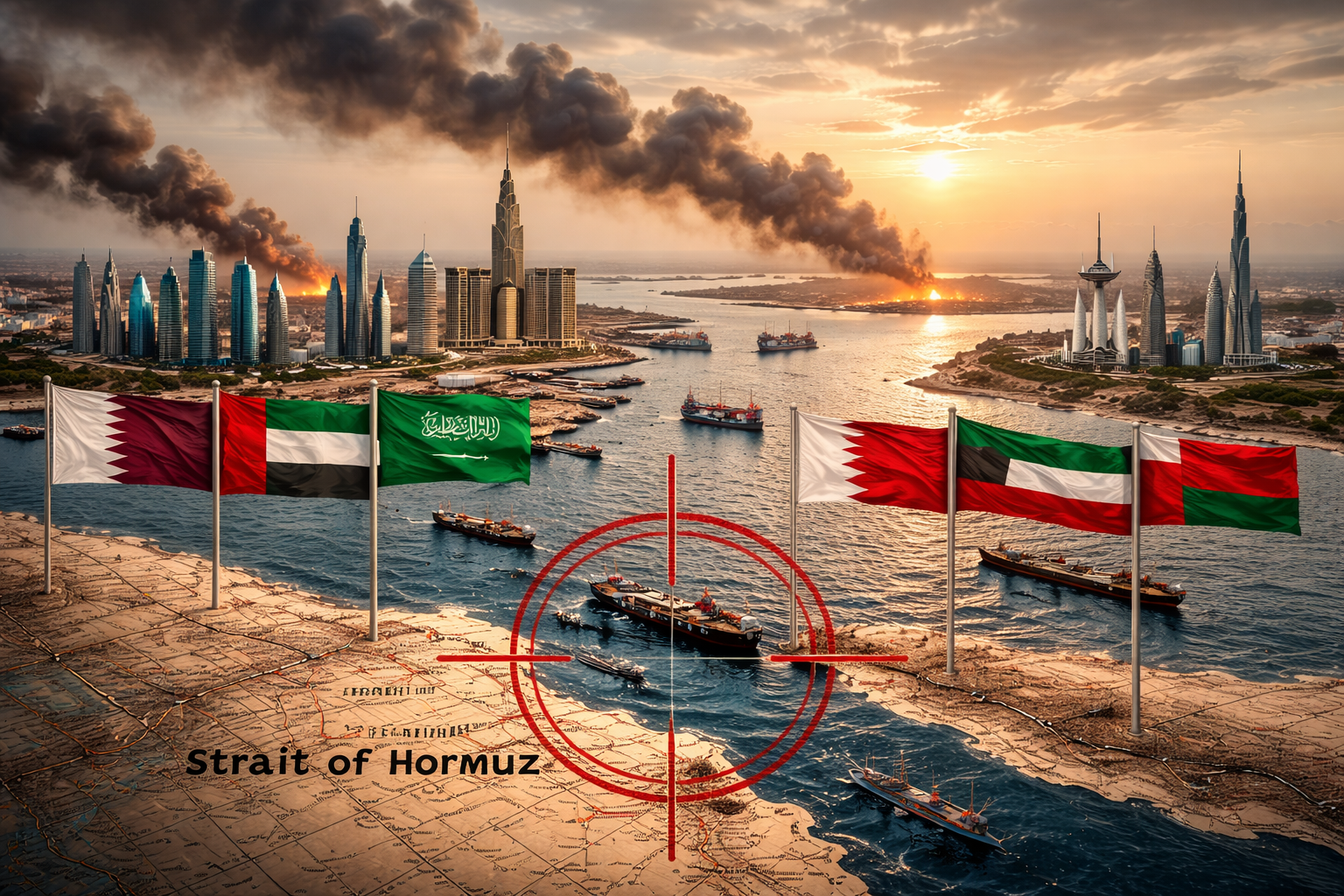
The Arab Gulf is home to six small nations that together sit atop roughly a third of the world’s proven oil reserves.
Today, they are more vulnerable than at any point since the Gulf War of 1991.
For decades, oil wealth powered their transformation. Petrodollars turned desert outposts into global hubs for finance, tourism, and logistics.
But the ongoing war with Iran has exposed how much of that modernisation still depends on one narrow chokepoint: the Strait of Hormuz, a 33‑kilometre‑wide passage through which nearly a fifth of the world’s oil flows every day.
Built on oil, trying to move beyond it
The Gulf’s vulnerability begins with its economic structure.
The region’s total GDP was estimated at $2.37 trillion in 2025, ranking it tenth globally, with Saudi Arabia alone accounting for more than half of total output.
Oil and gas still provide around 30% of GDP and between 50% and 85% of government revenues across the bloc.
Over the past decade, every Gulf government has worked to diversify away from this dependence. The UAE built Dubai into a global aviation and financial hub.
Qatar became the world’s largest LNG exporter. Saudi Arabia launched Vision 2030, betting on tourism, entertainment, and manufacturing.
As a result, non‑oil sectors now make up roughly 70% of real GDP, up from just 32% in 2022.
But diversification takes decades to become structural — and the new, service‑based sectors are the ones most exposed to geopolitical instability.
Six countries, very different starting positions
Qatar is the wealthiest per capita at $76,689 per person, richer than Switzerland.
Its economy is essentially a single massive LNG export machine, which made it extraordinarily prosperous in peacetime.
But virtually everything leaves via the Strait of Hormuz, and there is no Plan B for its exports.
Kuwait entered this crisis already weakened, having contracted 2.6% in 2024 before a single shot was fired.
Bahrain is the most fiscally fragile, carrying public debt of 146% of GDP and a budget deficit running at 10%.
The UAE is the most economically diversified country in the region, with alternative export routes and a services economy that was growing at 4% before the war.
Saudi Arabia remains the anchor, as its $1.08 trillion economy with Red Sea ports that can receive goods via the Suez Canal, bypassing Hormuz entirely.
Oman, located outside the Persian Gulf, is emerging as an unexpected logistics asset as its ports remain accessible without passing through the Strait.
Why is the Strait so dangerous?
The Strait of Hormuz is not just an oil route. It is the Gulf’s umbilical cord in both directions.
Oil and gas flow out, food and industrial inputs flow in.
The region imports 85% of its food, and current stocks would last four to six months, which sounds comfortable, as restocking is factored in.
Restocking requires the Strait of Hormuz to reopen, ports to function, and shipping insurance markets to normalise.
Iran understands this leverage.
By blocking the strait and simultaneously targeting refineries, banks, and the regional offices of US technology companies, Tehran is applying maximum economic pressure while signalling to Washington that the cost of escalation is global.
Goldman Sachs analysts suggest that if the Strait of Hormuz remains closed through April, GDP contractions of minus 14% for both Qatar and Kuwait, minus 5% for the UAE, and minus 3% for Saudi Arabia.
The Gulf’s worst Covid contraction was around 6%.
A minus 14% contraction for Qatar would be its deepest slump since the early 1990s.
What is breaking down right now
The industrial cascades are already visible.
QatarEnergy shut down aluminium, polymer, and methanol production after two major facilities were hit in early March.
Airlines in the UAE are running at 45% of pre-war capacity. Qatar’s aviation sector sits at 11%. Tourism has stopped.
In Bahrain, oil and aluminium revenues, which together fund two-thirds of the country’s budget, are both at a standstill.
Food price inflation is already generating political tension, with Qatar ordering the closure of several importers caught raising prices sharply.
One partial offset exists. Brent crude hit $103 per barrel in mid-March.
Higher oil prices help countries that can still export, primarily Saudi Arabia, whose fiscal deficit may come in smaller than its pre-war forecast of 3.3% if export volumes hold.
Buffers that might hold, ones that won’t
The Gulf’s greatest structural advantage is its sovereign wealth.
The UAE’s Abu Dhabi Investment Authority and Saudi Arabia’s Public Investment Fund are among the largest in the world, and Qatar and Kuwait hold enormous external assets relative to GDP.
This gives governments the ability to sustain spending for years, provided the war does not drag on.
Bahrain is the weak link. No sovereign wealth cushion, debt at 146% of GDP, and its two main revenue sources are offline simultaneously.
Without direct financial support from Saudi Arabia, which has stepped in before, Bahrain faces a genuine fiscal emergency within months.
Bond markets are not yet pricing in catastrophe, but analysts have been clear that prolonged conflict will change that.
What comes next?
Iran’s new Supreme Leader, Mojtaba Khamenei, has stated that Hormuz will remain closed for as long as the conflict continues, removing the possibility of a quick resolution.
Three outcomes are already taking shape.
Saudi Arabia is consolidating its role as the Gulf’s logistics hub, with infrastructure investments suddenly paying strategic dividends.
Oman is becoming a critical distribution node for goods flowing into the wider region.
And every government is accelerating its food security agenda, with local production now treated as a national priority rather than an afterthought.
For investors, the near-term picture is painful. For the patient ones, the aftermath will produce a large wave of spending on land routes, rail networks, food production, and energy resilience.
The $250 billion Gulf Railway project connecting all six nations by 2030 has gone from an ambitious plan to an urgent necessity.
The Gulf has rebuilt before, after 1991, after the 2014 oil price collapse, after Covid. But each crisis rewrites the region’s priorities.
This time, the lesson is that no amount of economic modernisation fully protects you when the water around you can be turned into a weapon.
The post How the Hormuz blockade, Iran strikes are reshaping Middle East economics appeared first on Invezz