
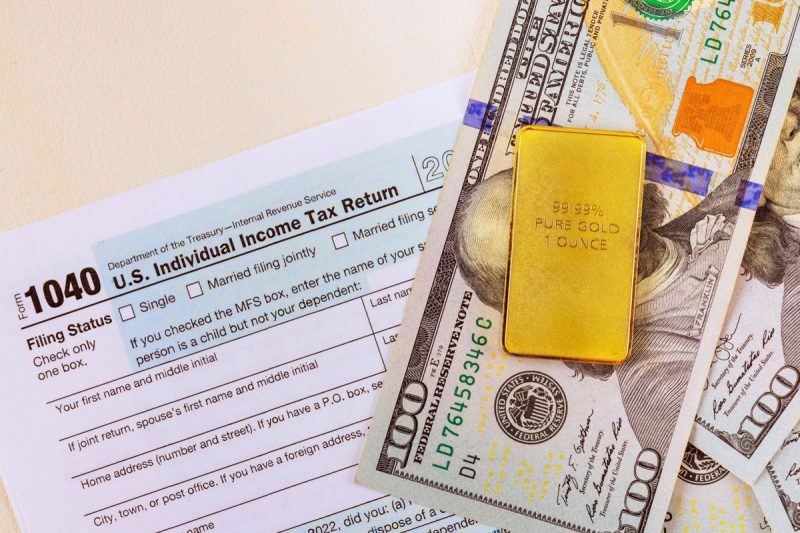
As gold and silver continue to prove their worth as sound investments, market participants should know how capital gains taxes are calculated for precious metals investments in the US.
While the majority of gold and silver investing comes with a certain degree of taxation, there are different levels of capital gains taxes based on how market participants decide to invest in these precious metals, how long the investments are held for and the investor’s individual tax bracket.
Read on for a breakdown of capital gains taxes associated with investing in gold and silver bullion, ETFs and stocks, as well as the forms involved with reporting precious metals investments.
In this article
How are capital gains from gold and silver bullion taxed?
Gold and silver bullion, coins and bars are seen as collectibles by the Internal Revenue Service (IRS) in the US. Thus, physical gold and physical silver, no matter the form, are subject to a higher rate of capital gains tax when they are sold. The same is true for fellow precious metals platinum and palladium.
While long-term capital gains would typically carry a top bracket of 20 percent, collectibles can be taxed at a higher 28 percent.
The total an investor will owe in capital gains tax when selling gold and silver bullion is based both on their income bracket and the length of time they held the asset.
The long-term capital gains tax on physical gold and silver is equal to an investor’s marginal tax rate, up to a maximum of 28 percent due to their status as a collectible, meaning those in higher tax brackets still only have to pay 28 percent on long-term gains from physical precious metals sales.
It is worth noting that the 28 percent maximum is only for long-term capital gains, which applies to metals that an investor has held for more than one year. Short-term capital gains on precious metals held for less than one year are taxed at ordinary income rates.
For example, a person in the highest tax bracket purchased 100 ounces of physical gold at US$1,800 per ounce and two years later sold their holdings for US$2,000 per ounce. While they are in the 37 percent tax bracket, they would pay 28 percent tax on the capital gains made from these sales. As they earned US$20,000 in capital gains, that would translate to US$5,600 in income tax.
However, if the investor sold the gold at the same gain just 11 months after they purchased it, it would count as short-term capital gains, and the investor would be taxed at 37 percent and owe US$7,400.
Investors who are in one of the tax brackets below 28 percent are taxed at the standard rate of their bracket when selling their solid gold and silver assets, whether they are held short- or long-term.
Similarly to other investments, precious metals sold at a loss can be used to offset capital gains.
How are capital gains from gold ETFs and silver ETFs taxed?
In terms of taxation, capital gain taxes from selling gold ETFs and silver ETFs can vary significantly based on the ETF’s holdings, the investor’s tax bracket and how long they held the asset for.
Funds will often supply investors with tax forms that they can use to fill out their income tax. The webpage for a fund should have a document describing how income tax is handled for that fund, which is worth reading before investing in it.
There are two main types of gold and silver ETFs: those that track the prices of precious metals and those that track gold or silver stocks.
ETFs that follow metals prices hold either bullion, or gold or silver futures contracts. It is important to keep in mind that investing in these ETF platforms does not allow investors to redeem gold or silver bullion, with few exceptions.
ETFs that invest in gold or silver companies provide hold gold and silver mining stocks, as well as precious metals royalty and streaming stocks.
So how much are investors taxed for capital gains on precious metals ETFs?
As mentioned above, it depends on the length they are held; short-term capital gains taxes apply to assets held less than one year, and long-term capital gains taxes apply to those held over one year.
Short-term capital gains made from selling gold or silver ETFs that hold physical metals or mining stocks will be taxed at the investor’s tax bracket, up to a maximum federal rate of 37 percent.
Long-term capital gains from selling gold and silver ETFs that hold stocks are capped at a 20 percent maximum federal income tax rate, because ETFs that hold stocks are taxed in the same way as traditional securities, which you can read more about in the following section.
Regarding gold and silver ETFs that hold physical metals, long-term capital gains from selling shares of these are subject to a 28 percent maximum rate because the holdings are considered collectibles, meaning they are taxed at the same rate as bullion as described in the section above.
Capital gains on futures-based commodity ETFs can often differ significantly from the others, as they can come with their own set of rules that you can learn about here. Briefly, futures ETFs are often taxed in a 60/40 hybrid, with 60 percent treated as long-term gains and 40 percent treated as short-term gains. Additionally, this is calculated at the end of each tax year, whether a sale is made or not.
Lastly, short-term and long-term capital gains on any ETFs could be subject to a 3.8 percent net investment income tax for high net-worth investors, and a state income tax may also apply.
How are capital gains from gold and silver stocks taxed?
In terms of tax on gold stocks and silver stocks, long-term gains from selling are subject to the standard 20 percent maximum federal rate, while short-term gains will face a maximum federal rate of 37 percent.
For investors in higher income brackets, there is the potential for gold and silver stock investments to also be hit with the 3.8 percent net investment income tax as well as state income tax.
Unlike physical precious metals and ETFs that hold them, precious metals stocks are not classified as collectibles, which is why the long-term capital gains tax is capped at 20 percent instead of 28 percent.
Stocks sold at a loss are important as well as they can be used to offset capital gains when filing income tax.
How to report taxes on physical gold and silver investments
Market participants who sell precious metals bullion in the US for a profit are required to report that profit on their income tax return, regardless of whether or not the dealer has any reporting obligation.
When selling gold and silver coins and bars in the US, there are two different sets of reporting guidelines — one applies to the dealer through which a person sells and the other applies to the investor who is selling the asset.
It is important to note that taxes on the sale of gold and silver will not be due the moment that the sale is made, and the tax bill for all of these sales is due at the same time as a standard income tax bill.
For investors selling precious metals, capital gains or losses need to be reported on Schedule D of Form 1040 when making a tax return.
Investors will first need to detail their precious metals transactions on Form 8949, including the length of time the investments were held. This form must be filed alongside Schedule D. Investors then use this information alongside the 28% Rate Gain Worksheet included in the Schedule D instructions.
Depending on the type of metal being sold, Form 1099-B may have to be submitted to the IRS by the broker when the sale closes, as such transactions are considered income. As for when a broker will need to file Form 1099-B, there are specific rules that determine which sales of precious metals require the dealer to file this form that apply to transactions over a 24 hours period.
For gold sales, reportable items include specific gold coins, including the 1 ounce Canadian Gold Maple Leaf and Gold Krugerrand, and gold bars and rounds of at least 0.995 fineness. As for quantity, only sales of more than 25 gold coins and or more than 1 kilogram in gold bars and rounds will require the form.
Sales of 0.999 fine silver bars and rounds totaling over 1,000 ounces are reportable. For silver coins, US coins with above 90 percent silver are reportable, but Silver American Eagle coins are not. Sales of silver coins exceeding US$1,000 will require a form.
When it comes to selling gold and silver overseas, market participants must follow the laws as they apply to the sale of gold and silver investments in that particular country.
The information in this article does not constitute tax advice, and investors should work with a tax professional or program to help them make sure everything is reported accurately.
FAQs for capital gains taxes on precious metals
Do you pay capital gains tax on gold?
Yes, US investors selling gold coins, bars and other bullion will be taxed on any capital gains made from those sales when reporting their income tax, with the tax rate dependent on whether the precious metals were held short-term or long-term and their tax bracket.
Are precious metals subject to capital gains tax?
Yes, sales of precious metals coins, bars and ETFs are subject to capital gains tax at varying rates. Because of this, you have to report gains and losses from precious metals on your income tax.
Are gold coins and bars exempt from capital gains taxes?
No, gold coins and gold bars are not exempt from capital gains taxes, meaning investors who sell their precious metals bullion must declare capital gains and capital losses on their income tax.
Securities Disclosure: I, Lauren Kelly, currently hold no direct investment interest in any company mentioned in this article.
The information in this article does not constitute tax advice, and investors should work with a tax professional or program to help them make sure everything is reported accurately.