
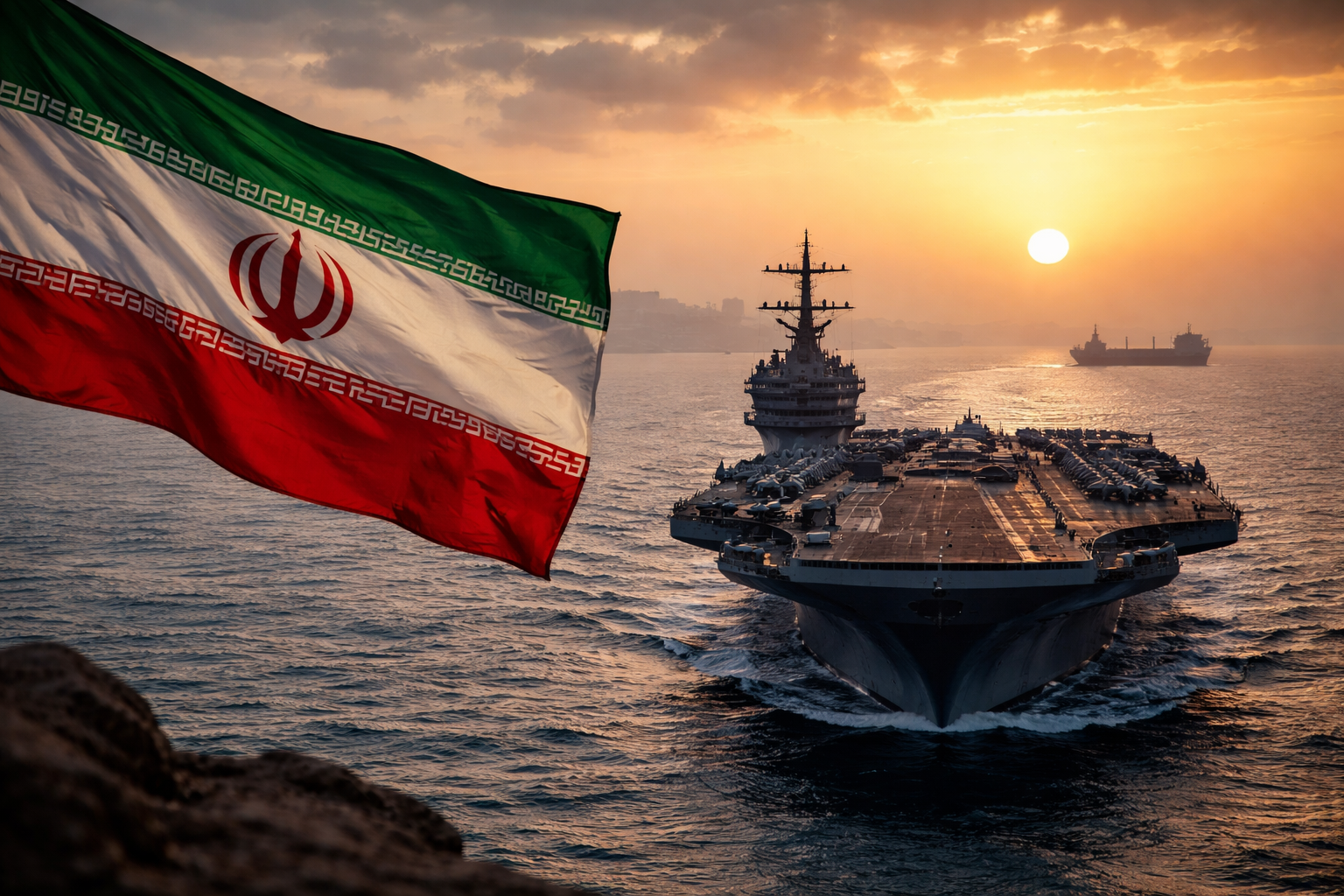
As US aircraft carriers are moving closer to the Gulf, oil prices are surging again, and gold climbed above the $5,000 mark, but equity markets remain relatively calm.
At the same time, Iran’s currency has collapsed to around 1.5 million rials per dollar, and inflation is running above 40%.
The military standoff, Iran’s economic strain and global inflation risks are now linked through one transmission channel, and investors may need to start pricing in some risks.
The risk is rising as diplomacy and force converge
The current phase of the US-Iran conflict did not emerge overnight.
Last year, the United States struck Iranian nuclear facilities, while Tehran continued advancing uranium enrichment and reinforcing military sites.
Indirect negotiations resumed in Switzerland, but the core disagreements remain unresolved.
The US is pressing for limits on enrichment and missiles. Tehran rejects terms it sees as capitulation.
Meanwhile, US naval deployments in the Gulf have expanded, and prediction markets now assign elevated odds to military action.
Regional powers are urging restraint, but energy markets are already adjusting to the possibility that talks fail.
A military deadline with real assets behind it
The United States has moved the USS Abraham Lincoln carrier strike group into position and ordered the USS Gerald R. Ford east, signalling a shift from deterrence to operational readiness.
President Donald Trump said the world will know within ten days whether nuclear talks yield a “meaningful deal” with Iran—or whether “bad things happen.”
Negotiations in Switzerland continue, but Washington’s demands—curbs on uranium enrichment, limits on missiles, and reduced support for regional militias—cut to the core of Tehran’s defence architecture.
For Iran, those measures would dismantle the foundation of its deterrent strategy, not just peripheral policies.
Why Tehran may prefer risk over rollback
Iran’s leadership faces a narrowing set of options. Conceding US terms would erode both its nuclear and regional leverage, undermining long-term security.
Yet its economic base is already under strain: the rial has lost 75% in a year, inflation remains above 40%, and food prices are up almost 60% year on year.
Roughly $15 billion in capital has left the country in six months, despite a trade surplus near $11 billion.
Economic weakness does not automatically mean de-escalation.
With deterrence credibility at stake, Tehran may view limited confrontation as less costly than structural retreat.
Oil is already responding
Brent crude has returned above $70. West Texas Intermediate recently traded near $66, the highest since August.
Around one fifth of global oil supply moves through the Strait of Hormuz. The broader Gulf region accounts for roughly one third of global output.
So far, oil is pricing a risk premium while equities are only marginally adjusting. The S&P 500 has experienced mild pullbacks, but no broad repricing.
Bond yields remain sensitive to inflation data instead of war risk.
The divergence is important as oil traders react to physical supply risk, while equity markets tend to wait for confirmation.
If flows through Hormuz were even partially disrupted, oil would likely move well beyond current levels. The move would not be linear. Energy markets adjust quickly when shipping risk changes.
The inflation channel is the real global risk
Higher oil feeds directly into headline inflation through fuel and transport costs. Central banks have spent two years trying to anchor inflation expectations.
The Federal Reserve’s latest minutes show concern that price pressures remain sticky. Markets are still debating the timing of rate cuts.
An energy shock would complicate that outlook. A renewed rise in headline inflation could delay easing or even revive hawkish guidance.
Higher yields would then pressure equity valuations, particularly in high multiple sectors.
In other words, a regional conflict would not stay regional. It would move through CPI prints and bond markets before it fully hits equity benchmarks.
Markets are assuming containment
Credit spreads remain relatively stable, the dollar’s gains are modest, and gold’s rally is contained, suggesting markets still view negotiation as the base case.
Regional mediators—Saudi Arabia, Qatar, and Oman—are pushing for restraint, aware that sustained conflict would harm even oil exporters by threatening infrastructure and shipping routes.
But tail risks are notoriously underpriced—until they’re not.
A single military strike or shipping disruption through Hormuz could trigger a rapid revaluation across assets, widening spreads and forcing equities to recalibrate volatility assumptions.
Iran’s fragile economic backdrop
Iran’s economy remains under extreme duress. Rising fiscal deficits, collapsing currency reserves, and deepening social strain heighten the risk of internal instability.
Any curbs on oil exports would cut foreign exchange inflows further, fanning inflation and potential unrest.
For Washington, regime fragility doesn’t necessarily translate into regional stability.
For Tehran, strategic rollback could carry greater long-term costs than confrontation.
Oil’s steady climb suggests energy markets understand this asymmetry.
Broader assets, for now, are still betting on diplomacy. If crude starts trading higher on structural supply fears rather than headlines, that assumption may quickly unravel.
The post US-Iran conflict risk and the market shock investors are ignoring appeared first on Invezz