
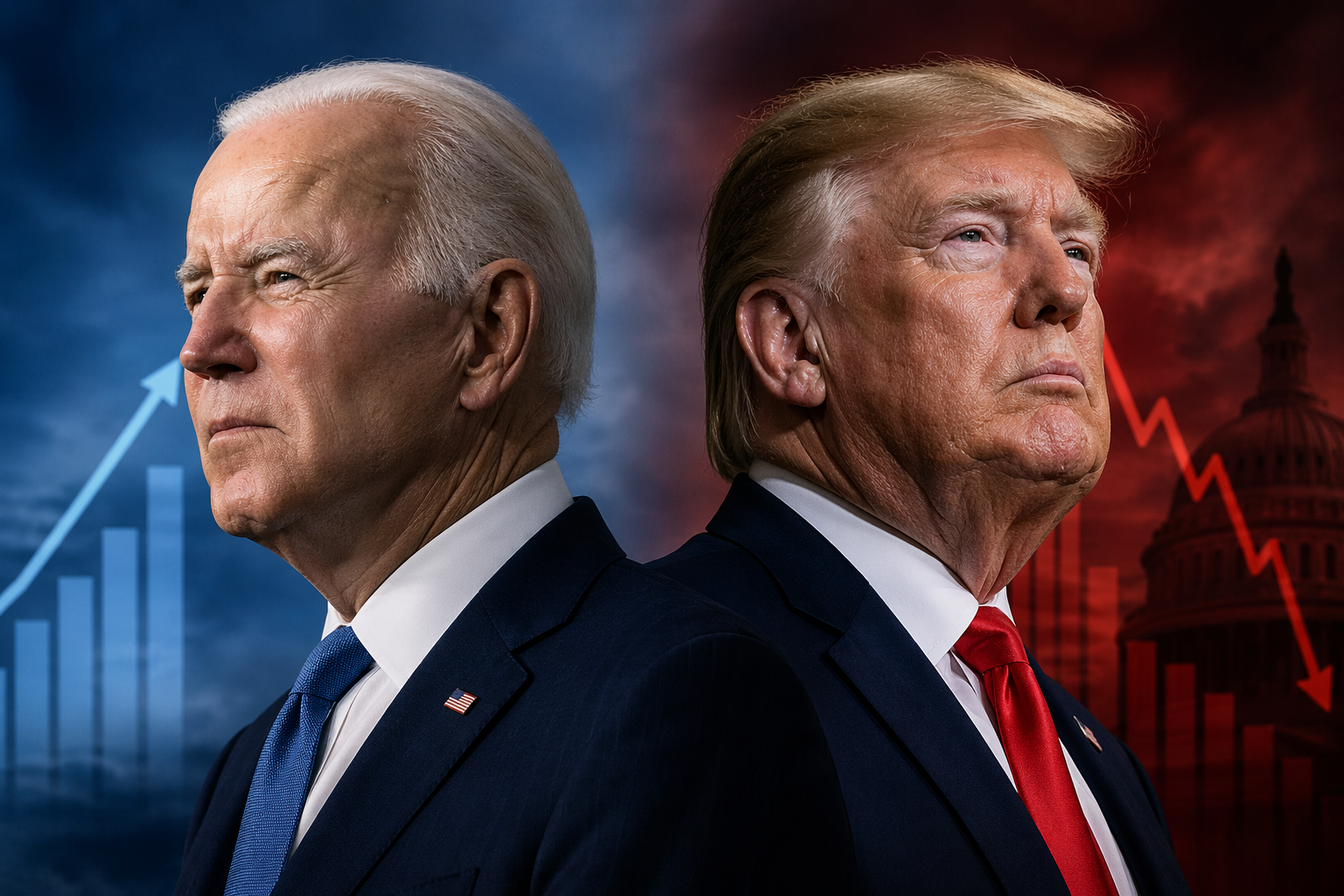
For the better part of four years, Americans lived in a paradoxical US economy.
It recorded record-low unemployment, produced 16 million new jobs, and wages were rising for the lowest-paid workers, while feeling, to a majority of households, like one of the worst in modern memory.
Donald Trump won the White House by hammering that feeling.
Fifteen months into his second term, the feeling has only gotten darker, and this time the data is starting to follow.
What Biden actually handed over
When Biden left office in January 2025, the numbers he passed on were objectively strong. Unemployment sat at 4.1%, down from 6.4% when he took office.
The economy had grown at or above 2.5% for four consecutive years, and the unemployment rate had been at or below 4% for 30 of the prior 38 months, a sustained run not seen since the late 1960s.
From mid-2022 onward, the US was generating around 240,000 jobs per month, nearly double the historical average.
Inflation had fallen from a peak of 9.1% in June 2022 to 2.7% by November 2024.
Wage growth for workers at the bottom of the income ladder had, in a development most economists called unexpected, outpaced wage growth at the top for the first time in 40 years.
Objectively, Donald Trump walked into the most advantageous economic inheritance of any incoming president in recent memory.
The inflation scar that changed everything
None of that mattered in November 2024, because grocery prices were 22.6% higher than when Biden took office, the steepest cumulative increase for any comparable period since 1982.
Rent. Gas. Mortgage payments. The numbers Americans felt daily bore no resemblance to the GDP figures economists were celebrating.
Some of it was genuinely beyond Biden’s control.
The post-pandemic supply chain collapse hit every advanced economy, and Russia’s invasion of Ukraine sent energy prices spiking globally.
But his $1.9 trillion American Rescue Plan demonstrably added fuel to demand-side inflation, a policy call most economists now acknowledge was excessive.
The result was a “vibecession“. An economy performing well on paper, while millions of families experienced it as a failure.
Sentiment cratered and never recovered. Trump spent two years telling voters their pain was real and that he would end it on Day One.
What has actually happened since?
Inflation came in at 3.3% year-over-year in March 2026, pushed by an energy surge from the US–Iran conflict, with core inflation at 2.6% and still above the Fed’s 2% target after five consecutive years.
Trump’s tariffs have ultimately raised the effective US import tax rate from roughly 2% to nearly 12% since he took office and added structural upward pressure on prices that predates the war entirely.
The labour market is where the damage is most visible. US employers added just 181,000 jobs in all of 2025, the lowest annual total outside of a recession since 2003.
Biden’s economy was generating that figure in a single month during most of his term.
The hiring rate has fallen to levels last seen during the depths of the 2008 financial crisis and the COVID recession.
People are not being fired, but almost nobody is being hired. GDP grew just 0.5% annualized in the fourth quarter of 2025, and the probability of recession in the next 12 months is now sitting at 45% according to the latest Wall Street Journal survey of forecasters, double what it was in January.
It is worth being honest about what we do not yet know.
Trump’s second term is 15 months old. Economies take time to respond to policy, and the Iran war has introduced a genuine exogenous shock that distorts the near-term picture.
Judging any presidency this early carries real limitations, and the full consequences of both the tariff regime and fiscal policy will take years to surface fully in the data.
How do Americans feel?
The University of Michigan Consumer Sentiment Index fell to 47.6 in April 2026, the lowest reading in the survey’s 74-year history, surpassing the prior record set during Biden’s inflation crisis in June 2022.
Three of the lowest readings ever recorded have now occurred in the past nine months of Trump’s second term.
A CBS News poll from the same period showed 63% of Americans rated the economy as “bad” and 65% disapproved of Trump’s handling of it, despite unemployment sitting at 4.3% and GDP still growing.
By January 2026, 53% of voters already believed the economy was worse under Trump than under Biden, a nine-point reversal from where sentiment stood at the start of his term.
The political lesson here is one both parties have now learned the hard way.
Biden delivered a broadly strong economy and was punished because the inflation experience felt catastrophic, regardless of what the wage data showed.
Trump promised to fix the economy and inherited it at its strongest, yet is now facing the same wall of public disillusionment, built this time from a hiring freeze, persistent inflation, tariff-driven uncertainty, and an energy shock.
Consumer confidence is not a lagging indicator. It shapes spending, hiring decisions, and investment long before the damage shows up in quarterly GDP prints.
When Americans feel this bad about an economy where unemployment is still near 4%, it is worth taking seriously, because historically, that gap between sentiment and data does not close in the direction of sentiment.
The post From grocery bills to oil prices, is Trump's economy worse than Biden's? appeared first on Invezz